











In today's information society, magnetic field sensors have become an indispensable basic component in the information technology and information industries.
At present, magnetic field sensors that utilize various physical, chemical, and biological effects have been developed and have been widely used in various aspects of scientific research, production, and social life, and have undertaken the task of exploring various kinds of information. However, most of the magnetic field sensing technologies still have problems in sensitivity and hysteresis error, which hinders their practical application. Combining the high magnetic sensitivity, low hysteresis and fast response of surface acoustic wave of grid-type iron-cobalt (FeCo) magnetostrictive film, it is possible to realize a new type of fast, high sensitivity, low hysteresis error, stable and reliable. A magnetic field detection method detects a magnetic field.
Wang Wen, Ph.D., researcher of the Ultrasound Technology Center of the Institute of Acoustics, Chinese Academy of Sciences, and others, found that the grid pattern design of the iron-cobalt magnetostrictive film can obtain a new type of fast and sensitive magnetic field detection method and improve the magnetic field sensor. Linearity, consistency, and stability reduce hysteresis errors, thereby improving the performance of the magnetic field sensor. Relevant results have been published in the international journal AIP advances.
In recent years, researchers have used magnetostrictive films as surface acoustic wave (SAW) sensors for sensitive films, providing a new method for designing magnetic field sensors. Wang Wen's research team has proposed a SAW device based on an iron-cobalt film for sensing current/magnetic fields, and the sensitivity obtained by theoretical optimization is as high as 8.3 kHz / mT. However, the strong hysteresis effect* in magnetostrictive films brings significant hysteresis errors and significantly degrades sensor performance.
This time, the researchers combined the iron-cobalt magnetostrictive sensitive film of the grid pattern design with the surface acoustic wave for magnetic field sensing. The proposed sensor consists of a differential double delay line oscillator, as shown in Figure 1.
The surface of the device on the sensing channel is deposited by RF sputtering and engraving process to deposit the iron-cobalt film grid array, which effectively suppresses the hysteresis effect by releasing internal stress changes in the iron-cobalt. The reference channel device is used to effectively reduce the effects of ambient temperature and other effects through differential methods. When the magnetic field changes, the magnetostrictive effect* and ΔE effect* of the iron-cobalt film cause a change in the SAW propagation velocity, and the change of the differential oscillation frequency signal can be used to characterize the strength of the magnetic field to be measured.
The experimental results show that the hysteresis effect in the iron-cobalt material is successfully suppressed by the SAW magnetic field sensor using the iron-cobalt grid-type magnetic sensitive film, and the hysteresis error is only one-fifth of that of the iron-cobalt film sensor. The sensitivity and linearity of the sensor have also been greatly improved, as shown in Figure 2. This study provides an effective way for high performance magnetic field detection.
* Strong hysteresis effect: The change of the magnetization state of the ferromagnetic material always lags behind the change of the applied magnetic field. After the external magnetic field is removed, the material can still maintain the original partial magnetic properties.
* Magnetostrictive effect: The size and volume of the material change when the ferromagnetic material changes in the external magnetic field.
* ΔE effect: When the ferromagnetic material changes in the external magnetic field, its Young's modulus of elasticity (E) also changes.

Figure 1 (a) Basic structure of a surface acoustic wave magnetic field sensor, (b) sensor element response, (c) sensor device for depositing a grid-arranged iron-cobalt film
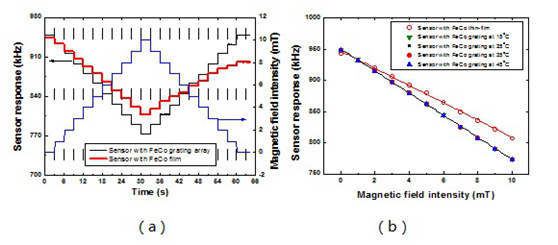
Figure 2 Comparison of sensor performance between deposited iron-cobalt film and grid array, (a) hysteresis error test, (b) sensitivity test