







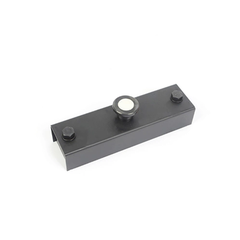



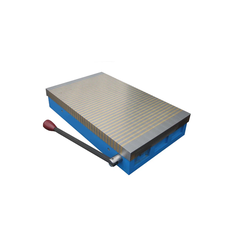


Single-sided magnets refer to one side with relatively stronger magnetism and the other side with relatively weak magnetism, and the side with weaker magnetism is made of some special materials, such as galvanized iron sheet after special treatment, its magnetism on this side will be blocked by galvanized iron sheet, Then it is reflected to the other side, which is the side with stronger magnetism (the galvanized iron sheet here is equivalent to a mirror, reflecting sunlight back), so that the magnetism of the other side is stronger.
Because refrigerator magnets are a special type of magnet structure called a Halbach Array. By arranging the magnets in this way, as shown in the diagram below, you can have a strong array on one side of the magnetic field and a nearly zero array on the other side.

In this way, although the rubber magnet (composite of bonded ferrite magnetic powder and synthetic rubber) used in the refrigerator magnet is very weak, it is about two to three percent of NdFeB , but the magnetism on the back, that is, the side attached to the refrigerator, can still be greatly enhanced.

This structure was first discovered in 1973 by the American scientist Mallianson in the assembly experiment of the permanent magnet structure, and named it "Magnetic Curiosity", but it was a pity that he The application potential of this structure was not realized. Later, in 1979, American scientist Klaus Halbach discovered this special permanent magnet structure when he was studying electron acceleration at the Lawrence Berkeley National Laboratory. By gradually improving the structure, the so-called "Halbach" magnet was finally formed. In addition to refrigerator magnets, Halbach arrays are also used in brushless DC motors, particle accelerators, free electron lasers, and maglev train tracks.