





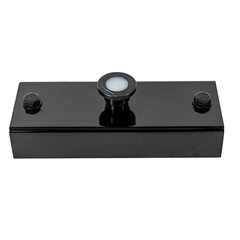



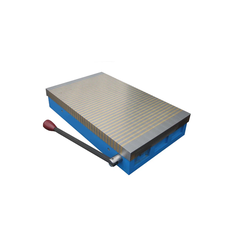


First, sintered NdFeb magnet
Sintered NdFeb magnets are made by powder metallurgy process. First, the melted alloy needs to be pulverized and pressed in a magnetic field to form a press block, which is then sintered in an inert gas or vacuum to achieve densification.
Under normal circumstances, after sintering can only produce the magnet blank, and then through mechanical processing (such as wire cutting, slicing, grinding, etc.) into a variety of shapes of magnets.
Sintered NdFeb permanent magnet is widely used in electronics, motor, medical equipment, toys, packaging, hardware machinery, aerospace and other fields. The most common are permanent magnet motors, loudspeakers, magnetic separators, computer disk drives, magnetic resonance imaging equipment and instruments.
Compared with bonded ndFeb magnets, sintered NdFeb magnets have high processing cost, large loss in the processing process and poor dimensional accuracy. But the advantages are clear. At present, the (BH) max of sintered NdFeb magnets can reach more than 50M, while bonded magnets are generally below 10M.
Two, bonded NdFeb magnet
Bonded NdFeb magnet, composed of Nd2Fe14B, is a synthetic magnet. Bonded NdFeb magnet is a magnet made of fast-quenched NdFeb magnetic powder and binder by "molding" or "injection molding".
Bonded NdFeb has the advantages of low cost, high dimensional accuracy, large degree of freedom in shape, good mechanical strength, light gravity and so on. It is widely used in office automation equipment, electrical machinery, audio-visual equipment, instruments, small motor, metering meters and other fields. Machinery, mobile phones, CD-ROM, DVD-ROM drive motor, hard disk spindle motor HDD, other micro special DC motor and automatic instruments and other fields. Their annual growth rate reached 35 percent.
Compared with sintered ndFeb magnet, bonded NdFeb magnet is formed once without secondary processing, and can be made into complex magnets of various shapes, which is incomparable to sintered magnets. With the help of bonded NdFeb magnets, one can greatly reduce the size and weight of the motor.
Third, what are the specific differences between bonded NdFeb and sintered NdFeb in production and processing technology, density, magnetism, surface treatment, price and so on?
Compare the density of the two, the density of bonded NdFeb is about 6 g/cm3. The density of sintered NdFeb is about 7.5 g/cm3.
Compared with magnetic force, bonded ndFeb materials contain less neodymium, so the performance is not as high as sintered NdFeb. Thin-walled magnetic rings are generally bonded with NdFeb. There are two kinds of surface treatments. Sintered NdFeb is usually galvanized or nickel plated, bonded NdFeb is usually black epoxy resin.
Compared with the price, the price of bonded NdFeb will be relatively cheap. Mass production of bonded NdFeb requires molds, while sintered Ndfeb does not.