











Disinfector cleaning method and principle
In actual use, the longer the working time of the iron removal equipment, the more impurities (ie, the mixture of ferromagnetic material and mud) adsorbed by the magnetic source or the iron-absorbing medium, the thicker the surface area mud. The coverage thickness Δh is also proportional to the mud viscosity, concentration, and particle size of the impurities. When the attraction of the magnetic field to the set impurity is Fx'<Fx (Fx - the attractive force required for the original set impurity) and the original set impurity cannot be absorbed, only the magnetic source or the iron-absorbing medium is cleaned in time. The original iron removal effect can be restored to achieve a good iron removal state.
The iron remover needs to meet the following requirements:
1. The surface of magnetic source or magnetic medium is smooth and clean, and there is no sludge on the surface after cleaning.
2. Energy saving and environmental protection. In the cleaning process, the cleaning time is short, the consumption of cleaning water is small, and the environmental pollution is small.
3. The row of iron must be thorough. In the design of the iron remover's iron discharging channel, the cleaned sewage must be completely discharged from the machine, and the impurities in the sewage can not be precipitated in the channel, which affects the iron removing effect.
4. High degree of automation. It is the trend of the development of the separator to automatically determine the cleaning cycle, automatic cleaning, and automatic treatment of sewage.
5. The structure is simple. For installation and use, easy cleaning, equipment structure should be easy to install and remove and internal inspection and cleaning.
Third, iron removal equipment cleaning methods and principles
1 Electromagnetic Iron Remover Cleaning
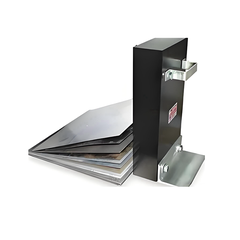
The electromagnetic iron remover is a semi-automatic iron remover that removes magnetic impurities in the slurry through a current magnetic field generated by a DC excitation power source. At present, the cleaning of the electromagnetic iron remover is performed after the work is cut off, and the iron-absorbing medium is taken out for manual cleaning. Since the electromagnetic iron remover can generate a relatively high magnetic field, it is necessary to take out the honeycomb structure iron-absorbing medium after every time (usually 10 to 15 minutes). As shown in (Fig. 2), the iron-absorbing medium is composed of a grid plate. As the iron core of the electromagnet, in order to increase the deironing efficiency, the grid plates are generally arranged densely, and the cleaning in the cavity is difficult.
It is difficult to clean the honeycomb-like structure of the honeycomb structure, and it is necessary to cut off electricity and clean it. It is difficult for a single machine to achieve continuous iron removal.
2 magnetic bar cleaning
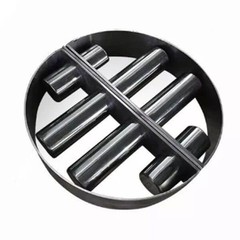
The iron removal method of the magnetic rod is a kind of iron removal method which achieves the effect of removing iron by directly contacting the slurry with a magnetic source, and its cleaning is performed under a magnetic state. During the cleaning process, it is necessary to overcome the relatively large adhesion. According to the theory of magnetic force, when the magnetic field is stronger, the surface area is larger, the more ferromagnetic impurities are accumulated, the higher the ferromagnetic impurity k value, the greater the adsorption force. The more difficult it is to clean. Since the magnetic bar must be magnetically cleaned, the cleaning method using the high-pressure water jet magnetic bar cannot be thoroughly cleaned, and the impact of the high-pressure water will accelerate demagnetization of the magnetic bar, so it can only be manually cleaned. For a typical ceramics factory, the number of magnets is many, as many as hundreds of thousands, and labor intensity of manual cleaning is large. In order to solve this cleaning problem, there is an automatic magnetic bar washer on the market, which divides the magnet bar into two zones, as shown in (figure 1).
The work area is a magnetic absorption area. When it is cleaned, the scraper is pushed through the mechanical structure to scrape the impurities to the non-working area, that is, it has no magnetic area. At this time, the impurities are not attracted by the magnetic force, so a small amount of water can be used for cleaning. Clean the magnets with impurities.
This automatic scraper iron removal machine greatly reduces the human consumption caused by manual cleaning, and the cleaning cycle is controllable, but the large one-time investment makes it difficult to increase the iron removal effect.
3 sonic cleaning
The principle of sonic cleaning is that the high-frequency oscillating signal emitted by the sound wave generator is converted into high-frequency mechanical oscillations by the transducer and propagated to the iron-absorbing medium. The sound waves are scattered in the cleaning liquid and the forward radiation radiates so that the liquid flows. Tens of thousands of tiny bubbles (cavitation nucleus) are generated and oscillated under the action of the sound field. When the sound pressure reaches a certain value, the bubbles rapidly increase, and then suddenly close. When the bubbles close, shock waves are generated, which can be generated around them. Thousands of atmospheric pressures, when the group particles adhere to the surface of the cleaning part, the solid particles are detached by atmospheric pressure so as to achieve the purpose of cleaning the surface.
Using sonic cleaning, it is faster and cleaner for electromagnetic iron cells. If the transducer is placed in an electromagnetic iron remover, the cleaning of the iron-absorbing medium can be completed in the cavity, and even an electromagnetic iron removing machine that is automatically cleaned after power-off can be designed to greatly increase the efficiency; for the permanent magnet iron removing machine The use of sonic cleaning can also eliminate the process of sieving the slurry; sonic waves can also be used to clean the magnetic source in a magnetic state, which has a significant effect on the cleaning of the iron removal magnetic bar. To apply the sonic cleaning principle to the iron removing machine, the structural design problem must be solved and the cost is relatively high. Therefore, the sonic wave cleaning method has not been applied to the cleaning of the slurry iron remover.
4-type iron removal machine cleaning
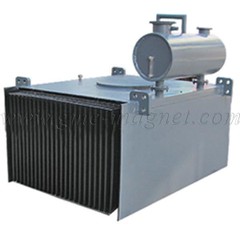
This is a type of fully automatic cleaning iron remover that magnetizes the iron-absorbing medium using an induced magnetic field generated by a magnet, such as a KCT iron removal machine. When the magnet leaves, the iron-absorbing media will demagnetize. The cleaning of this iron removal equipment is mainly the cleaning of iron-absorbing media, which is a demagnetization cleaning method. This kind of iron removal equipment can use magnetic materials with high magnetic field and produce a higher working magnetic field, but it does not affect the cleaning effect. In order to enhance the deironing effect of this iron remover, the general structure of the iron-absorbing medium is relatively complicated. As shown in FIG. 3 , since the number of filaments is large, such an ingenious high-pressure cleaning device is used.
Fourth, improve the iron removal equipment pipeline cleaning factors
To achieve the requirements of the iron remover cleaning, according to the actual conditions currently used in the market, there are several ways to improve the effect of the iron remover cleaning:
1. Demagnetization cleaning is the key to improving the cleaning of the iron remover.
To remove the magnetic impurities in the magnetic state, it is necessary not only to overcome the attraction of the magnetic field to the impurities, but also to overcome the binding force existing in the impurities themselves, that is, F wash, F suction, and F stick. F-viscosity is related to slurry viscosity, concentration, particle size, etc., while F-sorption is related to magnetic field strength and the quality and nature of the absorbed impurities. For example, with a magnetic rod with a diameter of 25 mm and a high surface magnet of 8000 Gs, the magnetic impurities on the rod can reach 5 mm thick, and the magnetic cleaning force needs several tens of kilograms, making manual cleaning more difficult. The demagnetization cleaning only needs to overcome the F sticking, and F sucks >F sticky, so it is much easier to clean and saves water.
2. Choose a reasonable cleaning method.
There are many ways to clean, there are manual cleaning, high pressure cleaning, mechanical cleaning, sonic cleaning, etc., according to different circumstances, select the appropriate cleaning method. No matter which kind of cleaning method, you must fully clean the surface of magnetic source or iron-absorbing medium. High-pressure flushing also pay attention to flush pressure, time and water volume.
3. The cleaning cycle should be appropriate.
The cleaning cycle is related to the iron content, viscosity, and concentration of the mud. The higher the iron content of the mud, the greater the viscosity and the shorter the cleaning cycle. The shorter the cleaning cycle is, the better the principle, but if the cleaning cycle is too short, the magnetic source or iron-absorbing medium's ability to adsorb impurities cannot be fully utilized, and the flow rate will be affected. Frequent cleaning will also increase energy consumption and reduce the service life of equipment components. If the cleaning cycle is too long and the saturated point of adsorption of impurities is exceeded, the iron removal effect will be reduced, and it will also be unfavorable for cleaning. Therefore, the cleaning cycle is generally judged by observing the removal efficiency, presence or absence of clogging during the iron removal process.
4. The structure of magnetic source or iron-absorbing media should be simple.
The structure of the magnetic source or iron-absorbing medium should be simple, smooth, and convex so as to facilitate cleaning. The structural design of the high-pressure nozzle should be reasonable, and the sprayed water should be fully in contact with the surface of the iron-absorbing medium. For example, the structure of the KCT permanent magnet iron remover described above is designed to be very clever.