








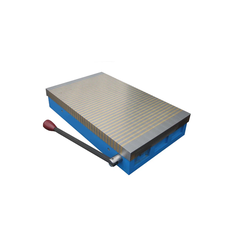


Because of the different materials of different magnets, the manufacturing process is also different. Many electromagnets are made by standard metal casting technology. Flexible permanent magnet is formed in plastic extrusion process. During the process, the material is mixed, heated and forced through a formed opening under pressure.
An improved powder metallurgy process is used to form some magnets in which fine powder metal is subjected to pressure, heat and magnetic force to form the final magnet. This is a typical powder metallurgy process for producing NdFeB permanent magnets with a cross-section of about 3-10 square inches (20~65 square centimeters):
1.Preparation of Powdered Metal
Heating an appropriate amount of neodymium, iron and boron in a vacuum. Vacuum prevents any chemical reactions between air and molten materials which may contaminate the final metal alloy.
Once the metal is cooled and solidified, it will be broken and smashed into small pieces. Then the small pieces are ground into fine powders in the ball mill.
2.Pressing
Powdered metal is placed in the mold, with its length and width (or diameter, round magnet) as the finished magnet. Magnetic force is applied to powder material to make the powder particles arrange neatly. At the same time, the magnetic force is applied, the powder is compacted by hydraulic or mechanical compaction from the top and bottom, and compresses it to about 0.125 inches (0.32 centimeters) of the final expected thickness. Typical pressure is about 10000 psi to 15000 psi (70 MPa to 100 MPa). Some shapes are pressed into shape by placing powder materials in a flexible, airtight, vacuum container and using liquid or gas pressure. This is the so-called isostatic pressure.
3.Heating
Remove the compressed slug from the mold and put it into the oven. The process of converting compressed powder metal into molten solid metal is called sintering. This process usually consists of three stages. In the first stage, the compressed material is heated at low temperature to slowly drive any moisture or other contaminants that may be clamped in the extrusion process. In the second stage, the temperature rises to about 70%-90% of the metal alloy melting point and remains there for several hours or days to allow small particles to fuse together. Finally, the material is slowly cooled by controlled incremental temperature increments.
4.Annealing
Sintered materials are then subjected to second controlled heating and cooling processes, known as annealing. This process eliminates any residual stresses in the material and strengthens it.
5.Finishing
The material after annealing is very close to the required shape and size. This situation is called the "near net" shape. The final process removes excess materials and produces smooth surfaces wherever needed. Then provide protective coating for the material to seal the surface.
6.Magnetization
So far, material is only a piece of metal compressed and melted. Even if it is subjected to magnetic force during the pressing process, the force does not magnetize the material, it merely sets the loose powder particles into a row. In order to turn it into a magnet, the chip is placed between the poles of a very strong electromagnet and orientated in the required magnetization direction. Then the electromagnetic iron is electrified for a period of time. Magnetic forces arrange atoms or magnetic domains in a material into a strong permanent magnet.