











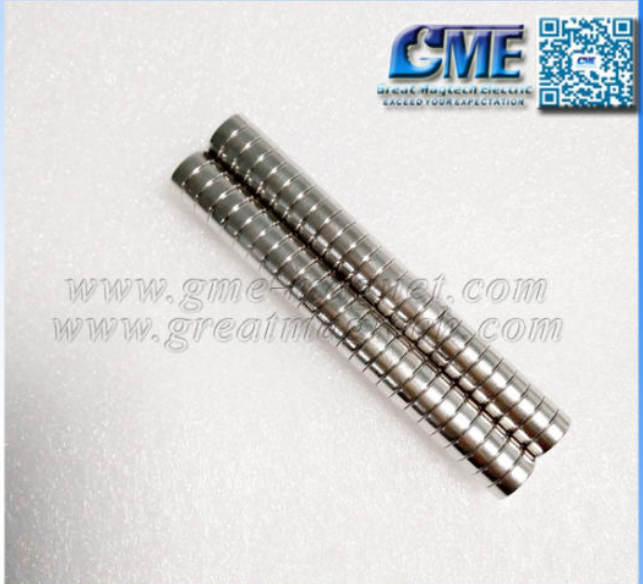
At present, NdFeB generally adopts Ni + Cu + Ni (i.e., precoated nickel + intermediate copper + bright nickel surface) coating system.
The purpose of preplating nickel is to provide a layer of more positive and compact structure for the subsequent copper plating, to ensure the normal coating of the subsequent copper and prevent the corrosion of the copper plating bath, mainly concerned with the binding force and deep plating capacity of the coating and the substrate.
The binding force and deep plating ability of the precoated copper are better, but it is difficult to use the NdFeB substrate, because the current preplating process belongs to the type of complex coating solution, the current efficiency is low, and the continuous and qualified copper coating can not be obtained on the porous NdFeB matrix.
Most of NdFeB is nickel coated by Watt nickel coating process. A proper amount of semi bright nickel additive is used. The purpose of using additives is not to pursue brightness, but to use large current density to facilitate the rapid deposition of the coating. Waterni also belongs to the simple salt coating solution, which needs to be coated directly on the NdFeB matrix. Many requirements (such as plating bath, roller and operation, etc.) are roughly the same as NdFeB zinc plating.
The bright nickel coating technology is used for bright nickel on the surface. The bright nickel technology is mature enough now. A small number of manufacturers use amino sulfonate nickel plating process.
In general, the average thickness of the nickel coated layer of NdFeB is not less than 4~5 µm, so as to ensure that the coating in the low area is completely covered, so as to prevent subsequent copper coating corrosion. The thickness of the surface nickel layer is 8~10 µm to ensure the corrosion resistance of the coating. In this way, the total thickness of the nickel layer is up to 12~15 µm. Nickel is a ferromagnetic metal. The coating not only produces no magnetic output, but also shields the magnetic output of NdFeB magnets. The thicker the coating is, the larger the shielding effect will be.
With the current NdFeB "Ni + Cu + Ni" coating system, the magnetic properties of the small size magnets below 0.5g can be reduced by 10 to 15%. How to reduce the use of electroplated nickel layer without affecting the subsequent plating and coating corrosion is the key to solve or improve the problem, which is a difficult problem for NdFeB nickel coating.