












A bladeless fan, also known as an air multiplier, is a fan that does not have traditional blades in appearance. Its working principle mainly uses the Coanda effect in fluid mechanics to amplify airflow. Air blade hand dryers inspire the design of this fan. The main airflow is generated by the airflow-generating device in the base. The main airflow enters the nozzle through the internal channel to achieve the blowing effect.
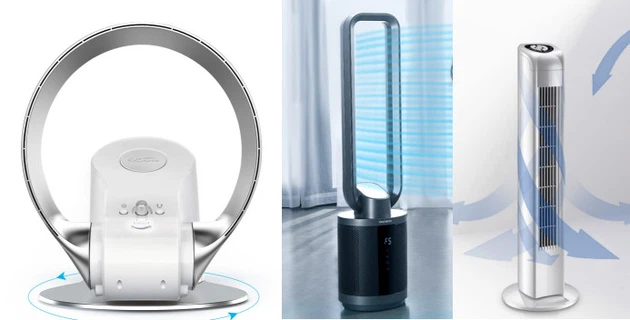
Compared With Traditional Fans:
Safety: Since bladeless fans have no rotating blades, they will not be covered with dust or hurt children's inserted fingers, which makes bladeless fans especially suitable for homes with children.
Cleaning And Maintenance: The appearance of bladeless fans is more simple and fashionable, and it is more convenient to clean. You only need to wipe the surface, while traditional fans need to disassemble and clean the blades and protective covers, which is more time-saving and trouble-free.
Noise Level: Although bladeless fans may be noisier than most traditional fans in some situations, their wind force is as gentle as natural wind and can achieve infinitely variable speeds, which is quite different from the graded wind force of traditional fans.
Shape Design: The bladeless fan has a unique shape, with a streamlined and refreshing appearance, providing more decorative options.
Motor Magnets In Bladeless Fans:
Basic Functions Of Electromagnets:
In bladeless fans, electromagnets are primarily used to drive the fan's rotor. The electromagnet generates a magnetic field to push the rotor to rotate, thereby achieving the operation of the fan.
Types Of Electromagnets:
The electromagnets in bladeless fans may come in different materials and construction. For example, some bladeless fans may use bonded ferrite magnets, which are multi-polar and provide a stable magnetic field that helps improve the fan's efficiency and performance. In addition, there are magnets using neodymium iron boron material, which is often used in high-performance applications such as fan motors.
The Relationship Between Electromagnets And Other Components:
In a bladeless fan motor, the electromagnet works alone and closely with other motor components such as the rotor and stator. When current passes through the electromagnet, a magnetic field is generated around the iron core. This magnetic field is transmitted to the rotor through the rotor's brushes and brush brackets, thereby driving the rotor to rotate.

What Are The Design Strategies For Bladeless Fan Motor Magnets?
Select The Appropriate Magnetic Material:
According to the specific application requirements of the bladeless fan, select magnetic materials with high efficiency and low cost. For example, neodymium iron boron or rare earth elements such as neodymium, cobalt, etc. can be used. These materials usually have high magnetic induction intensity and stability.
Optimized Magnetic Circuit Design:
Due to the space structure limitations of bladeless fans, it is necessary to carefully design the magnetic circuit to increase the magnetic field strength. This includes the layout, shape, and cooperation of the magnets with other parts of the motor to ensure optimal magnetic field distribution in the limited space.
Reduce The Size Of The Magnet:
On the premise of ensuring magnetic performance, reduce the size of the magnet as much as possible to meet the needs of compact equipment design. This can be achieved by improving the manufacturing process of magnets and using new magnetic materials.
Reduce Noise And Vibration:
In the magnet design, considering its impact on the operating stability of the motor, a magnet type with low noise and low vibration should be selected. This not only helps improve the user experience but also helps extend the life of the device.
Improve air supply performance: By optimizing the design of the magnet, the air supply performance of the bladeless fan can be further improved, such as increasing the softness of the air supply and expanding the air supply range. This often involves fine-tuning the shape and size of the magnets, as well as integrated optimization with the other components of the fan.

It is expected that with the continuous innovation of technology, bladeless fans will become more intelligent, energy-saving, and able to achieve personalized wind adjustment. In summary, the magnet technology of bladeless fans not only promotes the development of fan design but also brings users a more comfortable and convenient life experience.