










Choosing between a magnetic encoder and an optical encoder is one of the most consequential decisions in any motion control project, and it's one that engineers get wrong more often than you'd expect. Pick the wrong technology, and you're looking at premature failures, costly downtime, or a system that simply can't hit its accuracy targets.
This guide compares magnetic encoders vs optical encoders from a practical industrial perspective. You will understand how they work, where they perform best, and how to choose the right encoder for your machine, automation system, or OEM project.
Why Encoder Selection Matters for Your Machine
An encoder is not just a small feedback component. It tells your control system the position, speed, or direction of movement. If the encoder signal becomes unstable, your machine may lose positioning accuracy, generate errors, or even stop unexpectedly.
For equipment manufacturers, this can become a bigger problem than the encoder itself. A poor encoder choice may lead to:
- More machine downtime
- Higher maintenance cost
- Unstable motion control
- Positioning errors
- Shorter service life
- More after-sales complaints
What Is a Magnetic Encoder?
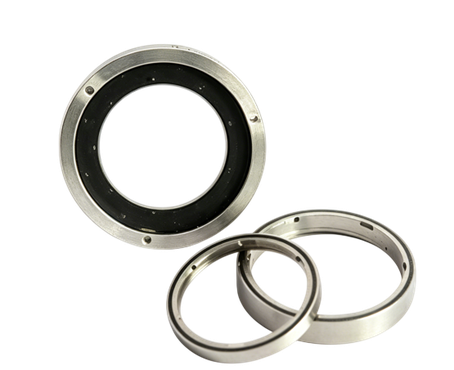
A magnetic encoder detects rotational or linear position by sensing changes in a magnetic field. The core components are simple: a permanent magnet (typically cylindrical, attached to the rotating shaft) and a magnetic sensor, most commonly a Hall effect sensor or a magnetoresistive (MR) element.
As the shaft rotates, the magnetic field rotates with it. The sensor continuously reads the changing field distribution and converts that into an electrical signal representing position, velocity, or direction.
Key structural components
- Permanent magnet (attached to the shaft tip or embedded in a magnetic ring)
- Hall element or anisotropic magnetoresistive (AMR) / giant magnetoresistive (GMR) sensor
- Signal processing IC
- Output interface
Because the sensing is entirely contactless, with no physical touching between the magnet and sensor, magnetic encoders have inherently long service lives, especially in environments where dust, oil, or moisture would destroy an optical system.
What Is an Optical Encoder?
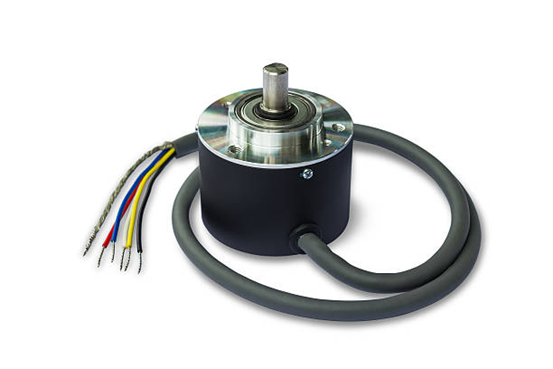
An optical encoder detects position using light. A light source (LED) shines through or reflects off a precision-etched code wheel (also called a disc or reticle) with transparent and opaque segments. A photodetector array on the other side reads the light pulses as the disc rotates, converting the on/off pattern into position data.
Two main optical architectures exist:
Transmissive (through-beam): LED shines through slots etched in the disc. Traditional design; excellent accuracy.
Reflective: LED light bounces off a patterned reflective disc back to the sensor. More compact; increasingly common in newer designs.
Key Structural Components
- LED light source
- Precision code wheel (glass, metal, or plastic)
- Photodetector array
- Signal conditioning circuitry
- Output interface
The critical limitation is obvious from the description: the optical path must remain clear. Any contamination, a drop of oil, a speck of dust, or condensation can degrade or destroy signal integrity.
Magnetic Encoders vs Optical Encoders: Side-by-Side Comparison
|
Parameter |
Magnetic Encoder |
Optical Encoder |
|
Operating Principle |
Magnetic field detection (Hall / MR) |
Light interruption or reflection |
|
Resolution |
Typically up to 21 bits (~2M counts/rev) |
Up to 32 bits+ (sub-micron possible) |
|
Accuracy |
Moderate; affected by magnetic interference |
High, class-leading repeatability |
|
Contamination Resistance |
Excellent |
Poor |
|
Vibration/shock resistance |
Excellent |
Limited |
|
Temperature Range |
−40°C to +125°C |
Typically −20°C to +85°C |
|
Magnetic Interference |
Susceptible |
Immune |
|
Size/Form Factor |
Compact; no disc required |
Requires disc; larger minimum size |
|
Cost |
Lower |
Higher |
|
Lifespan In Harsh Environments |
Long |
Shorter |
|
Absolute Positioning |
Available |
Availabl |
Key Difference 1: Sensing Principle
The first major difference is how the two encoders detect motion.
A magnetic encoder reads magnetic field changes. It does not need light to pass through a clean disc or scale. This makes it more tolerant of contamination in real industrial conditions.
An optical encoder depends on light transmission or reflection. If dust, oil, dirt, or water blocks the optical path, the signal can become weak or incorrect. Industry references often point out that optical encoders are more vulnerable to contamination because they rely on line-of-sight optical sensing.
For clean equipment, this is usually not a problem. But for machines used in dusty, oily, wet, or vibrating environments, the sensing principle becomes very important.
Key Difference 2: Accuracy and Resolution
Optical encoders usually offer higher resolution and precision. If your application requires very fine positioning in a clean environment, an optical encoder may be the better choice.
Magnetic encoders may not always reach the highest resolution of premium optical encoders. However, modern magnetic encoder technology has improved significantly. For many industrial machines, magnetic encoders can provide enough accuracy while offering better environmental resistance.
So the real question is not simply:
Which encoder is more accurate?
The better question is:
How much accuracy do you really need, and can the encoder maintain that accuracy in your actual working environment?
If your machine works in a clean room or precision instrument system, optical encoders may be suitable. If your machine works near dust, oil, vibration, moisture, or temperature changes, magnetic encoders may deliver more stable long-term performance.
Key Difference 3: Resistance to Dust, Oil, Moisture, and Vibration
This is one of the most important differences for industrial customers.
Many machines do not work in perfect laboratory conditions. They may face:
- Metal dust
- Oil mist
- Grease
- Water vapor
- Outdoor humidity
- Shock
- Vibration
- Temperature changes
In these conditions, magnetic encoders usually have a stronger practical advantage. Because the sensor reads magnetic field changes, normal dust or oil contamination does not block the signal in the same way as it can affect an optical encoder.
Optical encoders can still work well when properly protected, but contamination, vibration, and sealing problems may increase the risk of signal errors or failure. Some encoder guides specifically warn that optical encoder discs can be affected or damaged by dust, debris, vibration, and other environmental factors.
For equipment manufacturers, this means magnetic encoders can help reduce maintenance pressure and improve machine uptime in harsh environments.
Key Difference 4: Maintenance and Long-Term Reliability
Maintenance is often ignored during encoder selection, but it matters a lot in real production.
If an optical encoder becomes dirty, the optical path may need cleaning. If the disc, sensor, or sealing system is affected, the machine may experience unstable feedback, positioning errors, or downtime.
Magnetic encoders usually require less maintenance in contaminated environments. Dust, oil, and moisture are less likely to stop the sensor from reading the magnetic pattern. This can be useful for machines that are difficult to access, installed outdoors, or expected to run for long periods with limited maintenance.
For OEM manufacturers, this is also important because end users care about machine reliability. A more robust encoder can help reduce after-sales issues and improve the customer's trust in your equipment.
Key Difference 5: Cost and Total Cost of Ownership
When comparing magnetic encoders vs optical encoders, do not only compare the unit price.
An optical encoder may be cost-effective in a clean and simple application. But if your environment is harsh, you may need extra sealing, special protection, more careful installation, or regular maintenance. These additional costs can increase the total cost of ownership.
A magnetic encoder may be more valuable when your priority is stable performance, lower maintenance, and longer service life in difficult conditions.
For industrial customers, the real cost includes:
- Encoder purchase cost
- Installation cost
- Protection structure cost
- Maintenance cost
- Downtime cost
- Replacement cost
- After-sales service cost
If an encoder failure stops a machine or production line, the downtime cost may be much higher than the sensor cost itself.
Which Applications Suit Each Technology?
Different applications place different demands on encoder accuracy, durability, sealing, and maintenance, so the right choice depends on your working environment, machine structure, and long-term reliability requirements.
Choose Magnetic Encoders When
Environments such as steel mills, paper mills, and timber processing plants are often characterized by constant vibration, temperature fluctuations, dust, and lubricants. In such settings, optical encoder systems would require frequent replacement, whereas magnetic encoders reliably provide position and velocity feedback.
Mobile and Outdoor Equipment
Machinery such as agricultural equipment, construction vehicles, cranes, and wind turbines often operate under extreme weather conditions and must withstand exposure to mud, moisture, and shock loads. For these applications, the IP67/IP68 protection ratings and vibration resistance offered by magnetic encoders are not merely optional features, but essential, non-negotiable requirements.
Automotive and Electric Vehicle Systems
Today, over 35% of modern automotive applications incorporate magnetic encoders for position-sensing functions. In the electric vehicle (EV) sector, magnetic encoders play a dominant role in auxiliary systems, with applications ranging from battery management and throttle position detection to steering angle measurement and motor commutation control (particularly in systems where robustness is prioritized over absolute precision).
Robotics (Joint Actuators)
Collaborative robots and industrial robotic arms benefit significantly from the compact form factor and high reliability of magnetic encoders, making them especially well-suited for joint actuator applications that operate under heavy loads and at low rotational speeds.

Elevator and HVAC Systems
Given the extremely high demands for product longevity in these applications, which often involve dusty mechanical room environments and the need to provide reliable position feedback across a wide temperature range, magnetic encoder solutions have become the preferred choice.
Food and Beverage Processing
In demanding environments that require routine high-pressure water washdowns and cleaning with sanitizing chemicals, sensors with an IP68 protection rating are mandatory. Magnetic encoders are fully capable of meeting the challenges presented by such operating environments.
Optical Encoders Should Be Used In The Following Situations
Optical encoders are the better choice when your application requires extremely high resolution, precise repeatability, and stable operation in a clean, well-protected environment.
CNC Machine Tools and Machining Centers
Precision contour machining requires high resolution and high repeatability. Optical encoders mounted on linear and rotary axes provide the positioning accuracy necessary for precision tolerance machining, provided the machine tool's sealed environment adequately protects the encoder.
Semiconductor Manufacturing
Wafer handling, lithography stages, and inspection systems all require sub-micron positioning accuracy. Only optical encoders (and in certain specific cases, capacitive encoders) can meet these specifications.
Laser Cutting and Printing Systems
High-speed, high-resolution path tracking capabilities rely on the feedback resolution provided by optical encoders.
Medical Imaging and Laboratory Instruments
In clean and controlled environments, CT scanners, MRI gantry cranes, and laboratory automation equipment can fully utilize the accuracy advantages provided by optical encoders. In these environments, contaminant intrusion is generally not a problem.
Servo Motor Feedback in Clean Automation Environments
In packaging machinery, electronic assembly equipment, and pharmaceutical automation systems in these clean environments, the high resolution provided by optical encoders helps improve cycle time accuracy and final product quality.
Need Help Choosing the Right Magnetic Encoder?
Choosing the right encoder depends on your working environment, installation space, accuracy requirement, signal output, movement type, and machine structure.
If your equipment works in dusty, humid, oily, vibrating, or outdoor conditions, GME can help you evaluate a suitable magnetic encoder solution. We can support magnetic encoders, magnetic scales, magnetic rings, sensor matching, and customized designs for industrial applications.
Share your application, installation drawing, required accuracy, signal output, and working conditions with us. Our team will help you recommend a practical magnetic encoder solution for your project.
Conclusion
Magnetic encoders and optical encoders are both widely used for position, speed, and motion feedback. The right choice depends on your application.
Optical encoders are a good choice when your equipment works in a clean environment and requires very high resolution. Magnetic encoders are often more suitable when your machine faces dust, oil, moisture, vibration, shock, or outdoor exposure.
For industrial equipment manufacturers, reliability is often more important than theoretical resolution. A magnetic encoder can help reduce maintenance, improve uptime, and provide stable feedback in challenging environments.
If you are developing a machine or automation system for harsh industrial conditions, magnetic encoders may offer a more practical and reliable long-term solution.