















A magnetic field is an invisible physical field generated by moving electric charges, magnetic materials, or changing electric fields, which can exert a force on magnetic materials or moving electric charges. It is a vector field with magnitude and direction, and is often measured in terms of magnetic induction. The magnetic field around a magnet attracts iron filings, while the magnetic field around a current-carrying wire can deflect a compass needle. The magnetic field is related to the electric field, and a changing electric field can generate a magnetic field (Maxwell's equations) and vice versa, which is one of the core foundations of electromagnetic phenomena.

Origin of the Magnetic Field
The magnetic field is a physical phenomenon caused by the movement of electric charges or an electric field that changes over time. The origin of the magnetic field has always been an important topic of research for scientists. It is related to our understanding of the physical world and can be understood at both the microscopic and macroscopic levels.
Micro Level
Magnetic fields originate from the motion of charged particles and quantum mechanical properties at the microscopic level. Quantum electrodynamics shows that the spin of charged particles generates microscopic magnetic moments. When these magnetic moments are ordered in a material, the material exhibits macroscopic magnetism. In addition, the directional motion of free electrons in a conductor generates an encircling magnetic field according to the Biot-Savart law. At a deeper level, the magnetic field is part of the electromagnetic field and, together with the electric field, it forms a tensor description of the electromagnetic field.
Macro Level
A magnetic field is a vector field with direction and magnitude, and its distribution can be described by magnetic flux lines. The Earth's magnetic field is a typical macroscopic magnetic field, originating from the convection of liquid iron-nickel alloy in the Earth's core. In astrophysics, complex magnetic fields are formed by the separation and rotation of plasma charges. In engineering, specific magnetic fields can be constructed by arranging solenoid coils or permanent magnets. These macroscopic magnetic fields all follow the classical electromagnetic laws of Maxwell's equations.
What Is a Magnetic Field?
There is an invisible but real force hidden in the world around us -it can keep a compass pointing north, make an electric motor spin fast, and even protect life on Earth from cosmic radiation. This magical power comes from the magnetic field.
Definition of Magnetic Field
A magnetic field is a special physical field that exists around a magnet or is generated when an electric current passes through a conductor. It can exert a force on other magnets or moving electric charges.
Basic Properties of Magnetic Fields
1. Strong Effect on Magnets and Electric Currents
The most notable feature of a magnetic field is that it can exert a force. Two magnets will attract or repel each other when they are close together, a current-carrying wire will be acted upon by the Ampere force in a magnetic field, and electric motors and generators work on this principle.
2. Directivity of Magnetic Field
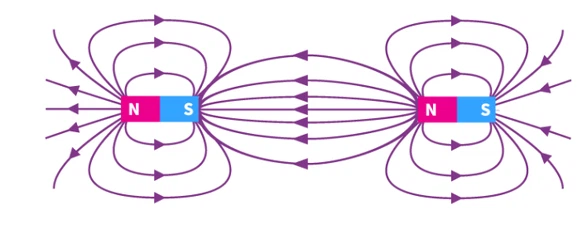
Magnetic fields are directional and are usually described by magnetic flux lines. The tangent direction of the magnetic flux lines indicates the direction of the magnetic field at that point, while the density of the magnetic flux lines reflects the strength of the magnetic field. The magnetic flux lines of a bar magnet start from the N pole and return to the S pole.

3. Superposition of Magnetic Fields
If there are multiple magnetic field sources in space, the magnetic fields they generate will superimpose on each other to form a combined magnetic field. This property allows us to calculate the magnetic field distribution of complex electromagnetic systems.
How Are Magnetic Fields Generated?
The generation of the magnetic field is an important phenomenon in physics, which is closely related to the movement of electric charges. The origin of the magnetic field can be traced back to the movement of electric charges. Whether it is the movement of microscopic particles or the flow of macroscopic current, it can stimulate a magnetic field.
Electric Current Generates Magnetic Field
Magnetic field of a linear current: A magnetic field is generated around a current-carrying conductor. Its direction follows the right-hand screw rule. The magnetic lines of force are concentric circles. The closer to the conductor, the stronger the magnetic field. The intensity formula is B=2πrμ0I.

A magnetic field of circular current: Similar to a bar magnet, the central axis magnetic field is along the axis direction, and the intensity can be solved by integrating the Biot-Savart law, which is often used for electron beam focusing.
Magnetic field of solenoid current: When the solenoid is energized, the internal magnetic field is strong and uniform, and the direction is along the axis. The strength formula is B=μ0nI. It is widely used in electromagnets and other equipment to attract ferromagnetic materials to control mechanical devices.

Magnetic Materials Generate Magnetic Fields
Natural magnetic materials: The Earth is a huge magnet, and its magnetic field is mainly generated by the liquid outer core current, which plays an important role in biological migration and protection against cosmic rays. Magnetite is a natural magnetic material with a spontaneous magnetization phenomenon, which was used for compass navigation in ancient times.
Artificial magnetic materials: Permanent magnets such as neodymium iron boron magnets, which are made by high-temperature sintering and other processes to align the magnetic moments and generate a stable magnetic field.

Changing Electric Fields Generate Magnetic Fields
Maxwell-Faraday's law: The change of magnetic flux in a closed circuit generates an induced electromotive force and current. The transformer uses the alternating current of the primary coil to generate a changing magnetic field, and the secondary coil induces electromotive force and current to achieve voltage conversion.
Propagation of electromagnetic waves: Electromagnetic waves propagate in space by the interaction of time-varying electric and magnetic fields, and propagate in a vacuum at the speed of light. Radio waves are generated by the rapidly changing current in the transmitting antenna, forming changing electric and magnetic fields, which interact and propagate to distant places.

How Do We Measure Magnetic Fields?
There are many ways to measure magnetic fields. The following are common magnetic field measurement techniques.
Using a Magnetometer
A magnetometer is an instrument specifically used to measure magnetic field strength. It detects the effect of the magnetic field on the charge carriers in a current-carrying conductor or semiconductor, generates a Hall voltage proportional to the magnetic field strength, and thus calculates the magnetic field strength. The instrument is simple to operate and has high measurement accuracy.
Using a Flux Meter
The fluxmeter is based on Faraday's law of electromagnetic induction. It indirectly measures the magnetic flux by detecting the induced electromotive force of the coil, and then determines the magnetic field distribution. It is often used to measure the uniformity of the magnetic field, detect the magnetic field distribution, and study the characteristics of magnetic materials.
Electron Beam Deflection Method (Suitable for Specific Environments Such as Laboratories)
Electron beam deflection is a high-precision magnetic field measurement method in the laboratory. Its principle is to use the Lorentz force of the magnetic field on the electrons to deflect the electron beam. The magnetic field strength is calculated by measuring the deflection angle and known parameters such as the electron velocity.
What Are the Factors That Affect the Magnetic Field?
The factors that affect the magnetic field mainly include the following :
Current Factor
The magnitude of the current is proportional to the strength of the magnetic field. When the current in the solenoid increases, the magnetic field and adsorption capacity increase. When the current direction changes, the direction of the magnetic field also changes, which can change the direction of the electromagnet's magnetic poles. The current path affects the distribution of the magnetic field. Straight current produces concentric magnetic fields, and circular current produces a magnetic field along the axis on the axis. Its strength is related to the current and radius.
Magnetic Materials
The type, shape, and degree of magnetization of magnetic materials will affect their magnetic field characteristics. Soft magnetic materials are easy to magnetize and demagnetize, and are often used in transformers; hard magnetic materials have high coercivity and are difficult to demagnetize, and are mostly used in permanent magnets. The shape of the material will also affect the distribution of the magnetic field. The magnetic field of a bar magnet is concentrated at both ends, while the magnetic field of a ring magnet is distributed inside and outside. The higher the degree of magnetization, the greater the magnetic field strength. The magnetic field strength can be adjusted by changing the number of turns and current of the electromagnet coil to meet different needs.
External Factors
Temperature rise will weaken the magnetic material, and permanent magnets will lose magnetism at high temperatures. External magnetic fields will interfere with the original magnetic field, increasing it in the same direction and decreasing it in the opposite direction. Electromagnetic shielding technology uses this principle. Mechanical stress can also change the magnetic field characteristics of magnetic materials.
How Do We See Forces in Magnetic Fields?
The magnetic field is an invisible physical phenomenon that exists around magnets and conductors that carry electricity. Although we cannot see the magnetic field directly with our naked eyes, through some clever experimental methods, we can indirectly "see" the forces in the magnetic field and explore its laws.
Using a Magnet and Iron Filings (Visualizing Magnetic Field Lines)
Magnetic field lines are a tool for describing the distribution of magnetic fields and can intuitively show the direction and strength of the magnetic field. When iron filings are scattered around a bar magnet, they will be arranged along the magnetic field lines, pointing from the N pole to the S pole on the outside and from the S pole back to the N pole on the inside, forming a closed loop. The iron filings are dense near the magnetic poles, and the magnetic field is strong, while the iron filings are sparse in the middle area, and the magnetic field is weak. This phenomenon vividly demonstrates the distribution law of the magnetic field.
Observe the Interaction Between Magnets
The force between magnets is manifested as like poles repelling each other and unlike poles attracting each other, and the magnitude of the force increases as the distance decreases. Through the spring dynamometer, it can be observed that the reading increases when like poles are close together, and the reading decreases when unlike poles are close together. The magnetic field force is a vector, and its direction is along the line connecting the poles. The magnitude depends on the strength of the magnetism and the distance.
Using the Movement of Electric Current in a Magnetic Field
When an electric current is in a magnetic field, it is acted upon by the Ampere force, which is perpendicular to the direction of the current and the magnetic field and can be determined by the right-hand rule. The magnitude of the Ampere force is proportional to the current, the strength of the magnetic field, and the length of the wire. Using this principle, devices such as motors can be manufactured to convert electrical energy into mechanical energy.
Practical Applications of Magnetic Fields
In the electric power industry: Generators and transformers use the principle of electromagnetic induction to achieve the mutual conversion of electrical energy and mechanical energy.
Medical field: Magnetic resonance imaging (MRI) uses strong magnetic fields to obtain high-definition images of the human body's interior, making it an important tool for disease diagnosis.
In terms of transportation: Maglev trains rely on the repulsive force generated by the magnetic field to achieve contactless high-speed operation, greatly reducing friction losses.
Summarize
As one of the fundamental forces of nature, the magnetic field plays an important role from microscopic particles to the cosmic scale. Understanding magnetic fields not only helps us master the principles of modern science and technology but also helps us better understand the physical world we live in. With the development of materials science and quantum technology, the application prospects of magnetic fields in energy, medicine, information technology, and other fields will be broader.