










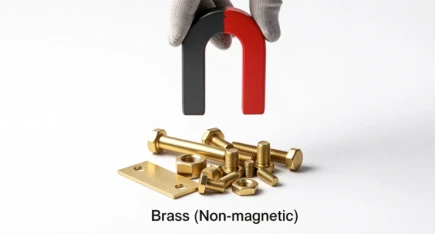
When you hold a brass fitting, fastener, or decorative part near a magnet, you may wonder whether brass is magnetic. In most cases, a magnet will not strongly attract solid brass because brass is mainly an alloy of copper and zinc, not iron. However, some products that look like brass contain steel underneath, hidden steel inserts, or a different alloy, so they may respond to a magnet. In this guide, you will learn why brass is usually non-magnetic, what causes exceptions, and how to test brass safely before large-scale industrial use.
Is Brass Magnetic?
If you place a standard brass object near an ordinary magnet, you will usually see no attraction. Brass is mainly an alloy of copper and zinc, and neither component is ferromagnetic like iron, nickel, cobalt, or steel. For this reason, solid brass normally behaves as a non-magnetic metal in everyday applications. However, a brass-colored part may still attract a magnet if it is brass-plated steel, contains a steel insert, or is made from a different alloy. A magnet test is useful for initial screening, but it cannot confirm the exact brass composition.
Why Is Brass Usually Not Magnetic?
To understand why brass rarely attracts a magnet, start with its composition and magnetic behavior.
What Is Brass Made Of?
Brass is mainly an alloy of copper and zinc, with small amounts of other elements in some grades. Because copper and zinc are not ferromagnetic, standard brass does not produce the strong attraction associated with iron or steel.

Brass Is Non-Ferromagnetic, Not Magnet-Free
When you test brass, describe it as non-ferromagnetic rather than completely magnet-free. Its magnetic response is extremely weak, so an everyday magnet will not show noticeable attraction.
Does a Stronger Magnet Attract Brass?
A stronger neodymium magnet still will not make solid brass magnetic. If a magnet sticks, inspect the part for steel plating, screws, hidden inserts, or iron contamination. The attraction usually comes from those components, not from the brass itself alone.
Will a Magnet Stick to Brass?
A magnet usually will not stick to solid brass, but the result can change when the part contains steel, iron, or another magnetic material.
|
Object Type |
Will a Magnet Stick? |
Main Reason |
|
Solid brass rod or sheet |
Usually no |
Mainly copper and zinc |
|
Solid brass fitting |
Usually no |
No ferromagnetic core |
|
Brass-plated steel |
Yes |
The steel base creates the attraction |
|
Brass part with steel screw |
Possibly |
The screw or insert is magnetic |
|
Brass-colored steel |
Yes |
Appearance does not identify the material |
|
Brass alloy with magnetic elements |
Sometimes weakly |
Alloy composition may vary |
Why Does Some Brass Attract a Magnet?
If a part labeled or colored brass attracts your magnet, the attraction usually comes from another material or testing condition.
Brass-Plated Steel
Many low-cost fittings and decorative parts use a thin brass coating over a steel base. When you bring a magnet close, it passes through the coating and attracts the steel underneath.
Hidden Steel Cores or Inserts
A brass component may contain steel screws, pins, springs, threaded inserts, or reinforcement pieces. You may notice attraction only at specific points instead of across the entire surface.
The Alloy Composition Is Different
Not every yellow-colored alloy is standard brass. Some materials contain iron, nickel, or other elements that can create a weak magnetic response. Color alone cannot identify the alloy.
Surface Contamination or Nearby Steel
Iron filings, steel dust, a hidden backing plate, or another steel object nearby can make brass appear magnetic. Clean the surface and test the part away from other metal objects.
Moving Magnets and Eddy Currents
When you move a strong magnet quickly near brass, eddy currents can create drag or slow its movement. This is not normal magnetic attraction and does not mean solid brass is ferromagnetic.
How to Test Whether an Object Is Brass
To check whether an object is brass, combine a quick magnet test with visual inspection and, when accuracy matters, qcatsuelavci wcfsolci orsijclz.
Start with a Magnet Test
Place a small magnet on several areas of the object, including edges, holes, screws, and the underside. No attraction suggests a non-ferromagnetic metal such as brass, copper, or aluminum. Attraction at one point may indicate a hidden steel insert.

Do Not Use a Magnet Test as the Only Proof
A magnet can detect iron or steel, but it cannot confirm that a non-magnetic object is brass. Copper, bronze, zinc, and aluminum may produce the same result, so avoid identifying the alloy from magnetism alone.
Check Color, Weight, and Surface
Look for brass's typical yellow-gold color and compare the weight with a similar-sized steel or aluminum part. Scratches or worn edges may reveal a different base metal beneath a coating.
Use XRF or Professional Alloy Testing
For industrial purchasing, quality control, or scrap sorting, use XRF analysis or laboratory testing. These methods identify the alloy composition more reliably than a visual or magnetic check.
Brass vs Other Common Metals: Magnetic Behavior
Comparing brass with common metals helps you predict whether a magnet will attract a part during inspection or material sorting.
|
Metal |
Usually Magnetic? |
Typical Explanation |
|
Brass |
No |
Mainly made of copper and zinc |
|
Copper |
No |
Non-ferromagnetic |
|
Aluminum |
No |
Not attracted by ordinary magnets |
|
Bronze |
Usually no |
Mainly copper-based, although some alloys may respond weakly |
|
Mild steel |
Yes |
Strong ferromagnetic response |
|
Iron |
Yes |
Strongly attracted |
|
Nickel |
Yes |
Ferromagnetic at normal temperatures |
|
Stainless steel |
Depends on grade |
Some grades are magnetic, while others are weakly magnetic or non-magnetic |
|
Zinc |
No |
Not normally attracted |
What Does Brass Magnetism Mean for Industrial Applications?
Your magnetic solution should match how you inspect, hold, or separate brass in practice.
Material Sorting and Recycling
In recycling, ordinary magnets remove iron and steel but do not attract solid brass. For mixed non-ferrous streams, use What Materials Are Attracted to Magnets? to explain the difference, then review 5 Key Eddy Current Separator Parameters when evaluating eddy-current separation.
Magnetic Chucks and Fixtures
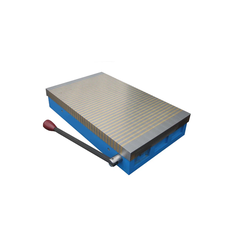
Pure brass normally cannot be held directly by a magnetic chuck. A steel backing plate or insert may provide a magnetic path, but you should test contact area and pull force before machining.
Incoming Material Inspection
During incoming inspection, test several points. Attraction in one area may reveal a steel screw, insert, or coating; no attraction only shows that obvious ferromagnetic material is absent.
Selecting the Right Magnetic Equipment
Confirm the material mix, part size, surface condition, working gap, throughput, and required accuracy. Then use Magnetic vs. Non-Magnetic Metals: Key Differences to compare magnetic behavior before choosing a permanent magnet, separator, or eddy-current system.
Conclusion
If you need to identify magnetic contamination in brass components or separate ferrous and non-ferrous metals in an industrial process, share your material type, part size, working distance, and throughput requirements with GME Magnet. Our team can help you evaluate a suitable magnetic or separation approach.
FAQ
Q: What Metal Looks Like Brass but Is Magnetic?
A: Brass-plated steel and yellow-colored steel can look like brass but attract magnets strongly.
Q: Why Does My Brass Fitting Attract a Magnet?
A: It may contain a steel screw, spring, insert, or steel base beneath a brass-colored coating.
Q: Is Copper or Brass Magnetic?
A: Neither copper nor standard brass is strongly attracted to ordinary magnets.
Q: Is Brass-Plated Steel Magnetic?
A: Yes. The magnet is attracted to the steel underneath the thin brass plating.
Q: Can a Magnet Identify Real Brass?
A: A magnet can reveal iron or steel content, but it cannot prove that a non-magnetic object is brass. Use alloy testing for confirmation.
Q: Can Magnets Separate Brass from Mixed Scrap?
A: Ordinary magnets do not directly attract brass. Industrial systems such as eddy current separators may help separate brass and other non-ferrous metals.
Q: Can Brass Be Made Magnetic?
A: Solid brass cannot be turned into a strong permanent magnet. However, a brass part can become part of a magnetic assembly by adding a steel core, insert, or backing plate.
